
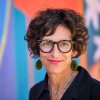

Teaching Korean at an all-boys high school was foundational for Ji Hong’s research as an educational psychologist.
But her curiosity about educators was piqued long before that when observing her parents, who were teachers in her native South Korea.
That interest and then research came into focus after she attended graduate school in Arizona and then Georgia. Now after four years in the educational psychology department at the University of Arizona, Hong is leading a study to understand why and how teachers from marginalized communities bring their identities and lives outside the classroom to their teaching and their students.
“That’s a great foundation for my research now because I learned through that experience that teacher identity, teacher motivation, teacher emotion,” said Hong, 49. “Those are super-critical components to shape teachers’ work and lives in school. And I have that first-time experience back in Korea.
“But I noticed that the U.S. had a lot more diverse race and ethnic backgrounds. And it’s a huge contrast between the two countries,” Hong said. “And probably my lens was more sensitized because of my background.”
The purpose of this study, according to the UA’s QTEACH 10-person team conducting it, is to gain a deeper understanding of how teachers whose identities have been marginalized navigate their professional and personal identities during challenging times. How are these teachers’ work and lives influenced by an anti-Diversity, Equity, and Inclusion climate?
Teachers’ experiences wanted
For more information on the UA’s educational psychology study, including if you qualify and compensation, go here.
Teacher and student ethnicity largely do not match, according to Arizona Department of Education Data. In 2024, Department of Education data showed teachers are overwhelmingly White (67%), with the remainder Hispanic (18%), Asian/Pacific Islander (5%), Black (4%), and Indigenous (2%). For the same year, student data showed 48% are Hispanic, 34% White, 6% African American, 4% Indigenous and 3% Asian/Pacific Islander.
About 3.5% of American teachers identify as LGBTQ, according to a 2024 study from Brown University, which highlights the need for more data on these educators to learn more about why they are underrepresented in teaching.
Arizona Luminaria asked Hong about the study, recruiting Tucson-area educators and how she hopes the results will be used. This interview has been edited for length and clarity.
Q: How does a teachers’ identity affect their work in the classroom?
A: Teachers’ work and lives are hard and challenging. But in the U.S., the race factor adds a huge dimension in their work and lives. For example, white teachers or if teachers’ gender or sexuality are aligned with societal norms — they don’t have to worry about who they are as a human. They just walk into the classroom. They are being welcomed. They’re accepted for who they are and they just need to worry about the teaching part, and classroom management, etc. But they don’t have to worry about who they are as a human. So, they’re not questioned or they’re not interrogated about who they are as a person. But in the U.S., I started hearing stories, especially learning about qualitative method. Those marginalized teachers, when their own personal identities like race, gender, sexual orientation, if those are not aligned with the societal norms, then they are constantly interrogated about who they are as a person: ‘Are you listening as a teacher? Are you a good enough teacher for my children?’ So sometimes it’s very explicit, sometimes implicit, but it’s there. I often think about this metaphor like they’re almost swimming. Swimming itself is hard. But they’re swimming in the resistance pool. There’s this constant current against who they are. So I started thinking, OK, then this is a serious problem on top of all the teacher shortages and everything.”
Q: Who/what uses your research and what do they do with it?
A: My research about marginalized teachers’ identity, work and lives has a significant connection to our community, especially teacher preparation programs and teacher development. For example, one of the key functions of the UA College of Education is to prepare future teachers and provide support for practicing teachers in Southern Arizona, where we serve a high proportion of Hispanic students. I believe it is important first and foremost to truly understand the marginalized teachers’ authentic, complex experiences, that were often silenced, erased, or misrepresented. From there, we can start addressing ‘how to improve that’ through teacher preparation programs and teacher development opportunities. For example, how can we stop microaggressions? How can we stop racism? How can we stop exclusive practices? How can we change inequitable policies? If we don’t know what problems are, then we cannot find solutions either. So I believe this research is the first step of many steps that we need to pursue collectively.
Q: What do you hope this research and this study in particular accomplishes?
A: I think answers for this question goes back to the fundamental question about why I do research. I believe research should be able to address problems in our society, in our education. The lack of true diversity, inclusiveness, and equity are permeated in every aspect of education.
I advocate research aimed at doing the greater good, that engages participants with the intent to humanize and ascribe to them the authentic complexity that characterizes their humanity. So, it is important to centralize the social-cultural-historical contexts and broaden the empirical lens acknowledging the role social structures play with respect to race, gender, sexuality, and other marginalized social identities in shaping experiences. I believe it is through scholarly work aimed at rehumanizing, engendering respect for the heterogeneity of communities, that our work can truly be transformative.
Q: How can a teacher participate in the study or get more information?
Go to this link. About 80 teachers are needed.

