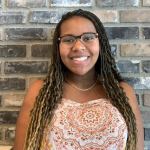
Erin Adams writes about things that make your skin crawl but listen to her talk for more than five minutes and you are gonna laugh. Today, she’s joking about avoiding spoilers as she talks about her Black Horror novel “Jackal.”
“I’m trying to find a way to talk about the book without giving too much away!” Adams says with a bright smile that contrasts her darker literary genre. “I want people to read it.”
Adams seems lively by nature. She is also a writer of very real themes about being a Black woman in America.
In a quote from her novel, she sums it up: “One drop in this country is all it takes. Being a Black girl is inhabiting a cruel riddle: Your beauty is denied but replicated. Your sexuality is controlled but desired. You take up too much space, but if you are too small, you are ripped apart. Despite the wash of it, that’s one thing you can always count on whiteness to do: destroy a threat.”
Black Horror is a relatively new, exciting genre that is being explored by Black authors and filmmakers alike.
Adams recently had one of her short stories featured in Jordan Peele’s new book, “Out There Screaming, An Anthology of New Black Horror.” Peele, an actor, writer and director, is also a big name in the realm of Black Horror. With movies like “Us” and “Get Out” spearheading the rise of the genre.
Adams is also an actor, storyteller and a first-generation Haitian-American who grew up in a small mountain town in Pennsylvania. On her website she shares why she chooses art to express the untold and unseen: “There are so many people who are made to feel invisible, purely because they don’t fit the stories told about them. My work as an artist strives to widen that narrow narrow foot path.”
Arizona Luminaria chatted with Adams in advance of her visit to the Tucson Festival of Books on March 9-10, 2024.
Watch out for spoilers, listen for truths and broaden the narrow, narrow path.
This interview has been edited for length and clarity.
Q: Can you give us a brief overview of “Jackal” in your own words?
A: Yeah! So “Jackal” follows a young Black woman named Liz, who grew up in the Rust Belt, and after many, many years away she comes home for her best friend’s wedding. And she says she’s gonna come, do the wedding, and just leave: 36 hours, in and out.
At the wedding, the bride’s young daughter, Caroline, vanishes in the middle of the reception. This huge hunt begins for this girl and as they’re looking for Caroline, Liz realizes that, ‘Oh, wait, all of this feels really really familiar.’” And something just like this happened when she was in high school.
As she starts to dig into that she realizes, “Oh no!” There’s been a series of missing children in this town But because they’re all young Black girls, they’ve been explained away, or swept under the rug, and it’s been allowed to happen for a long, long time. So now she has to find out what’s really happening before it’s too late for Caroline, and in many ways before it’s too late for herself, too.
2024 Tucson Festival of Books
The Tucson Festival of Books — March 9-10 — is an annual event held on the University of Arizona campus, drawing more than 100,000 people, including hundreds of authors and celebrities. The fest brings in people of all ages for one thing: Books!
Authors across all genres, and all from different backgrounds and walks of life, have the chance to share their stories. Whether that be through book signing tables, social gatherings or panel talks with various authors, there is something for writers, readers and gawkers alike.
See the schedule of author presentations, including three events featuring Erin Adams.
What inspired you to write this story? I am from Johnstown, which is where the book is set and I decided, you know, to put it in my own backyard, so to speak. Around 2017, I felt this unfamiliarity upon coming back. I felt this hostility in a place that you’re supposed to call home, and it was something that wasn’t surprising. That’s where the seed of “Jackal” came from.
Also, I love folk tales. I love folk tales and urban legends, because they are what we as a society kind of make up. Sometimes we can’t answer these terrible, unanswerable questions. So I started trying to make up my own folk tales and make up my own monster, so to speak. That’s just the seeds, for like a little bit of it as well.
Then also adding in the horror elements of that and what is terrifying about feeling and being in a hostile place — that’s also your home. What’s terrifying about that and how can that be expanded upon? How does that kind of hostile home feeling, feel unfortunately familiar as a Black woman in America? I grapple with the unfortunate fact that if something happens to me, like if I literally disappear, it will be treated differently than everybody else, and that in and of itself is horrifying. I wanted to write about that.
What is the meaning behind the title of your novel? “Jackal” has many, many layers. So just first starting off with: what a jackal is. It’s a scavenger. It’s an African dog. I remember when I first was pitching the book, people were like: Why is it called Jackal but it’s set in the Rust Belt? And for so much of my life, both when I was living in Johnstown and then after I left, people don’t believe where I’m from. Like I have people straight up telling me like, ‘Wait, aren’t you from California?’” I’m like, “No, no, no. I’m from a tiny mountain town in Pennsylvania.”
There’s always this idea that oh, Blackness doesn’t exist there, when it absolutely does. I love this idea of something that’s in the wrong place, so hence Jackal. Also with the scavenger, I find that a lot of pain in the Rust Belt comes from this idea and reality, that everyone is fighting over scraps. It’s like we’re all fighting over dredges of nothing sometimes. And that can drive people to become very afraid and very angry. But it’s from a completely justifiable space. Jackals are scavengers because they are usually ostracized by other animals, and so both Liz, the main character, and — I will do my best not to have any too many spoilers — the presence, if you will, are both these ostracized entities in their communities.
Horror as a genre has a rich history and often explores societal fears and anxieties. How does “Jackal” contribute to this tradition, particularly from the perspective of a Black author? “Jackal” is in many ways, like a big grab bag of all the things that I feel like either I grew up fearing, or people I know grew up fearing. A lot of “Jackal” was just my — and I would argue many Black people’s — inherent fear of the woods. Don’t go in the woods! What are you doing? Get out of there! And I was just fascinated by them like, why are the woods a sight of horror for Black folks? I wanted to explore something there.
Because, yes, the woods are a sign of horror for Black people in America, but they’re also a site of freedom. Slaves had to literally run north, through the woods, for their freedom. So yes, I want a book, with Black characters, set in the woods, and I wanna talk about it a whole bunch.
Research can be an important aspect of writing horror, especially when incorporating cultural or historical elements. What kind of research did you undertake while writing “Jackal?” In doing research for “Jackal” I looked into cases of missing Black girls. It’s just devastating, to be honest. There are sites that are usually run by families that have the missing posters and have the information. In some cases I was able to look at, you know, interview transcripts, and even in the interviews I would feel my neck itching, because in interviews you can hear the tone in people’s voices. They’re like, ‘OK, but did you watch her? Were you home? What was she wearing?’” And it’s like, she’s a child! And she’s gone!
So some of that I included in “Jackal.” There are transcripts. There’s newspaper articles. There’s descriptions of missing girl flyers. And all of that can feel a little incomplete. But that’s what I was experiencing in my own research. The amount that you can find is really based on how involved the family is, and how much the family wants to put out there. I wanted to do my best to engage with this in a way that felt honest and felt victim-focused.
You’ll see in the way the chapters are structured, we get moments with each of the victims before they pass in a way that wasn’t exploited, and we are mourning them in the girl’s chapters.
Yes, we’re mourning the loss of these girls, but in many ways the girl’s chapters also mourn the loss of Black girlhood, and how it kind of happens overnight. It’s like I woke up one day and I was a woman. I’m like what the hell? I still like Barbies! But you’re over here telling me that I need to be behaving or acting, or that I inherently am, a certain way.
So a lot of the chapters are a mourning of that very brief time that Black women get to be girls.
Horror fiction can sometimes serve as a vehicle for social commentary. Are there any underlying themes or messages in “Jackal” that you hope readers will pick up on? I’m usually loath to tell anyone what they should grab from a book. I would say, just take what you need. Of the grab bag of things that are to take from “Jackal,” I would say, there’s a huge theme about anger and about being “an angry Black woman” and how that’s both used to silence Black women, and it’s also our super power at the same time.
Anger can be powerful and not silencing. When we self-police our anger, who is that really benefiting? Is it really beneficial to us to be good? Who does our goodness benefit? Does it really benefit us, or is it benefiting the people who are holding us down?
Stereotypically in the horror genre the Black characters never make it to the end credits. How does “Jackal” address these stereotypes commonly found in horror fiction, especially surrounding Black characters? There are certain expectations as the book goes on, where, especially when it comes to Caroline, and when it comes to Liz as things get real dark, you’re like, ‘Oh, is anyone gonna make it out?’” I hope that in some ways the book subverts those expectations and stereotypes, where it does successfully give you what you want, but not in the way you expect.
I would argue that yes, certain people who we think are done for survive, but there is a cost. I remember when I pitched my ending to my editor, she was like, ‘You’re gonna piss people off.’”
In the case of “Jackal,” the cost of what it is for folks to survive in the end is ultimately what brings justice. When it came to the ending I just wanted to do my best to tell the truth in an honest way.
As a Black author writing horror, what individual perspectives or experiences do you feel that you bring to the genre, and how do they influence the storytelling in your novel? As a Black person writing horror, and writing horror about Black people or the Black experience, you just have a totally different set of rules you’re playing by. You’re approaching everything from a different angle. You’re coming at it sideways — especially when horror can be about critiquing or taking a look at societal norms and turning them on its head.
Then, me being a Black woman, it’s like I have a massive advantage, like, I see the world differently. A good example of this is in the movie “Get Out.” At the end of the movie we see the police pull up and we’re all preparing ourselves for, you know, this inevitability of the demise of this Black character. I would say that just having that different perspective is what makes Black Horror unique. It’s where when the heroes show up, you’re like: The heroes for who?
How do you envision your novel contributing to the broader landscape of Black Horror literature? That’s one where I’m kind of like, just do it! Just exist! “Jackal” is something I am so proud of. Just to say, I’m gonna talk about the stuff we don’t want to talk about, and I’m gonna do it for 350 pages.
I hope that “Jackal” has a place in the Horror genre as being: Black. Women. Horror. Period. The book cover itself is even bright red. It’s like we’re talking about Black women, and there’s conversations around femininity. The main character cuts her off in the beginning of the book, and loses one of those “feminine markers.”
There’s talk about femininity. There’s talk about anger as a Black woman. This book is also gruesome, and there’s graphic stuff, but somehow the book itself still feels very much within the Black woman’s experience, like the femme experience, and I love that. It has so much range, like it’s angry, it’s beautiful, it’s gross. It’s all of these facets.
So if I could have any hopes for its place in the genre, it would be that Black women can write horror, too. We can write Black Horror about ourselves and it can be just as terrifying and scary and heartbreaking and even fun, as everything else.