
Wall-sickness, or Mauerkrankheit, is a German term for a psychological malady that infected people who lived near the Berlin Wall. That wall came down over three decades ago, but the idea of “wall-sickness” has been used since to describe the mental impact of living near other militarized international border walls, including the one that cuts through the Sonoran desert.
Mauerkrankheit is what Russ McSpadden, a Southwest conservation advocate for the Center for Biological Diversity, says bit him starting in about 2019. At the time, he was documenting the environmental destruction taking place as the first Trump administration was rapidly erecting miles of wall along the U.S.-México border.
During the first Trump administration, and again now, McSpadden says he would “go and stare at the wall a lot. I’d go and watch mountains being blown up, get dragged aside to make room for them to build a wall.”
The experience shook him.
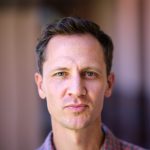
Field notes and jotted phrases from his observations, from trips to check field cameras tracking wildlife, or hikes with his son near the border, eventually started taking poetic form. A grant and encouragement from a University of Arizona English professor, Johanna Skibsrud, linked him up with another local author and poet, as well as publisher, Logan Phillips. Phillips and Skibsrud urged McSpadden to keep writing and, eventually, to shape his poems into his first book, “Borderlings,” which was published by Artspeak Press last year.
Despite the darkness that pervades many of the poems, “Borderlings” isn’t all bleak. McSpadden also celebrates life and finds hope as he records “the joyous assembly in the high desert whorl.”
This conversation has been edited for clarity and length.

Credit Russ McSpadden / Center for Biological Diversity
Q. Can you describe the origins of this book?
A. The origins of the book are largely field notes that I was taking over five or six years starting around 2017. I was going in the field to some of these places where we thought that the Trump administration might start building a border wall. I was largely doing work with the intent of protecting threatened and endangered species in the Arizona-Sonora borderlands. A lot of that is media work, taking photographs and documenting the destruction. Sometimes multiple times a week I would be out in Organ Pipe Cactus National Monument to document wall construction, the blasting of cultural sites, or drilling. I was also out in places like the San Bernardino National Wildlife Refuge, all along the Devil’s Highway, Cabeza Prieta, camping out and tracking construction. Some of that was for potential legal challenges, some just for spreading the story.
Years later, around 2022, Logan [Phillips] occasionally started joining me to check wildlife cameras. We were also out together at the encampment blocking [former Arizona Governor Doug] Ducey’s wall in the San Rafael Valley. And on a lot of these long truck rides Logan and I would talk poetry.
Q. Was writing the book therapeutic for you?
A. A little therapeutic, yeah. I wanted to ask, How do you still love? How do you still hope? How do you still live when the future seems destined for greater government control?
Q. What do you mean by greater government control?
A. The border wall for me portends a more violent and brutal future. It looks like a landscape-level prison wall. The border wall may seem to be an inevitable conclusion at the moment, but caring for each other in the face of it is an act of resistance.
Q. This book is also very personal. You write about your mother, son, about different bodies.
A. There are human bodies, animal bodies, and the bodies of the landscape in the book. There’s my own body. My son’s body. I ask how do you be a parent in a place that is both beautiful and violent and ugly at the same time? How do you care for your community, how do you care for the ecosystems around you? I’m asking those questions. I don’t believe my book has any answers to them.
Q. You write lines about that beauty you find, but also portray the landscape as a knife, or describe “paranoid satellites” flying overhead. What was it like to try to put such diametric feelings into sometimes a single poem, or at least a single book of poems?
A. Especially in the borderlands, there are so many beautiful things about this place: the human communities here are absolutely vibrant and powerful, and the landscapes are so biodiverse and beautiful and mysterious beyond compare.The wildlife are outrageously amazing. I’ve been on trails, because I can tell from my trail camera, where just days before a bear and a jaguar and an ocelot have just walked by. And a Mexican spotted owl, too. You know, there’s only 1,500 Mexican spotted owls on the whole fucking planet, and one lands right on this branch in this same exact spot, right? In the book I say that there’s no magic in the borderlands, but I’m just trying to ground myself. Because it feels like there’s this incredible magic in these human and wild communities in these lands.
Q. You’re drawn to borders?
A. I feel like I’ll spend my life trying to talk about how beautiful the border really is. But there are two different kinds of borders, this kind of hyper-politicized, stagnant border that’s imposed by the state on the landscape. And then there’s these real borders in this region, this continental biogeographic transition zone.
There’s an interplay and a movement and an expression of interchange that happens along these borders, and that’s where really amazing things happen in the world of culture and art and cuisine, but also in the world of evolution. Borders are where abundance and diversity of life comes from on so many levels.